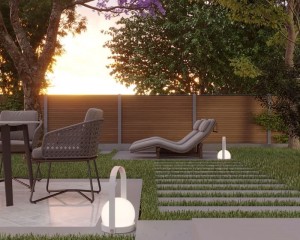
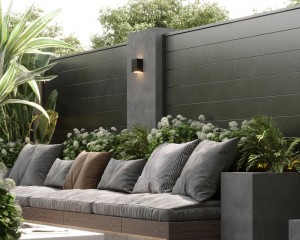
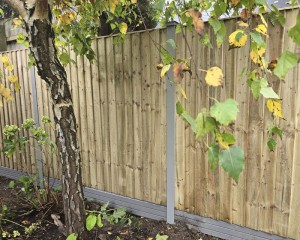
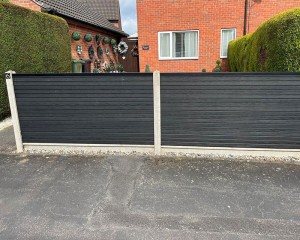
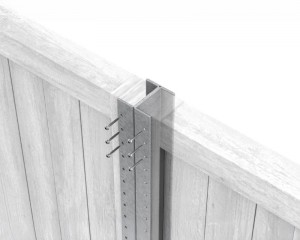
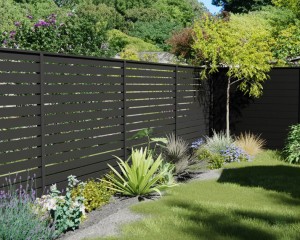
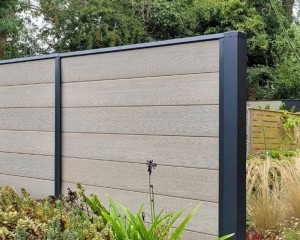
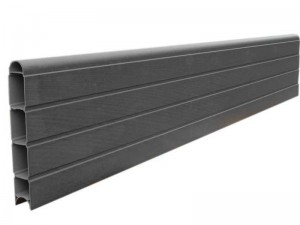
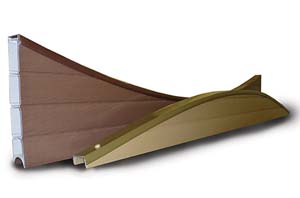
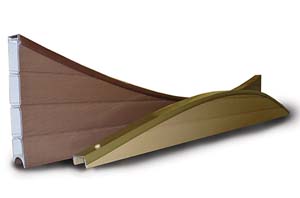
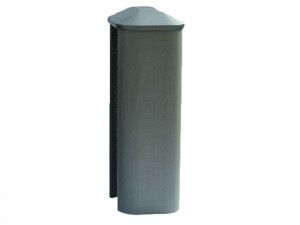
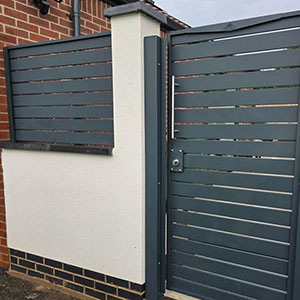
Browse our composite fencing range below, including boards and panel systems compatible with slotted fence posts.
Composite fencing is manufactured from a blend of wood fibres, wood flour or rice husks, plastic (typically recycled PVC, especially in our mode-fencing), and UV stabilisers, creating robust boards that slot together to form solid fence panels. Composite panels are designed to withstand harsh outdoor conditions with minimal upkeep, whereas timber often requires repainting or staining to stay protected. With correct installation, composite fencing is commonly expected to last over 20 years.
Application
- Composite fencing is commonly used for:
- Garden boundary fencing
- High-end domestic landscaping
- Privacy fencing
- Modern residential settings
- Noise-reduction boundaries - especially with mastic and acoustic backing
Whilst composite fencing works well for residential applications, it is also well-suited to public-facing areas due to its durability, consistent finish, and minimal maintenance. One excellent feature is the low splinter risk, making it perfect for schools and nurseries.
Specialist Applications
Due to its durability, it works incredibly well in areas that timber simply isn’t as suited. Damp, shaded landscapes that can accelerate timber rot are of little concern to composite panels, and bright, open areas with long hours of direct sunlight are better handled thanks to UV stabilisers within the material. Combined with the natural salt resistance, the composite can be an ideal choice for coastal properties that need secure, long-term fencing and privacy.
Composite Fencing Vs Traditional Timber
- Low maintenance
- No painting, straining, sealing, sanding or rot treatment required
- Cleaning is typically as simple as rinsing down, a light scrub, or a gentle pressure wash (avoid excessive pressure at close range)
- Rot, insect and moisture resistance
- The recycled plastics protect the composite panels from rot, insects, damp, and make it mould and fungus resistant.
- Stability
- Composite is designed to reduce common timber problems such as warping, twisting and splitting. Boards may expand and contract slightly, but panels will keep their alignment, maintaining security, privacy and acoustic performance over time.
- Colour stability
- The colour is not a stain or paint but a pigment mixed through the material, meaning scratches and damage will maintain the overall colouring. Whilst some fading will occur over time, it keeps and maintains the colour much longer than wood would.
- Longevity
- With minimal maintenance, composite fencing is commonly expected to deliver 20 to 30 years of service, depending on conditions.
- Timber panels often struggle to reach 10 years without regular maintenance and may show issues earlier.
- Sustainability
- Composite boards are commonly made using a high proportion of recycled material, blending recovered plastics with organic fibres such as wood or rice husk. This reduces demand for virgin timber and helps divert plastic from waste streams.
- The longer replacement cycle also reduces the environmental impact associated with more frequent repair and replacement.
- Safety
- Composite fencing is not prone to splinters, making it perfect around children and family environments.
- Cost
- Composite fencing typically costs more upfront, but its longer lifespan and low maintenance requirements can make it more cost-effective than timber over the full lifecycle.
Types of Composite Fencing
Composite fencing comes in a few different formats. The most common variations are the material composition (for example, wood-plastic composites vs rice husk composites) and the stabilisers used for UV resistance and long-term performance.
In terms of layout, you can choose slatted/board-on-board systems (where boards slot together to form the panel) or fully pre-assembled panels. Pre-assembled panels are quicker to install and often lower cost, while board-by-board systems offer more flexibility for stepped gardens, boundary height changes, and easier repairs. If a board is damaged, modular systems allow you to replace a single section rather than an entire panel.
PVC vs Composite Fencing
PVC fencing is made entirely from plastic and is valued for its lightweight construction, moisture resistance, and low maintenance. It will not rot, splinter or attract insects, and is often supplied in pre-formed panels for quick installation. However, PVC can be more prone to thermal expansion and contraction, and its smooth finish can appear more overtly plastic, particularly in brighter colours.
Composite fencing combines plastic with organic fibre, creating a denser, more rigid board with improved dimensional stability and a more natural, timber-like appearance. While composite fencing typically costs more upfront, it offers greater strength, reduced movement over time, and a finish that better suits premium residential, public access, and long-term boundary applications.