Your Basket is Empty
A good-quality timber gate can provide many years of service, but correct installation and aftercare are just as important as the gate itself.
Unlike a metal or composite gate, a wooden gate is made from a natural material that continually responds to its surroundings. Changes in moisture, temperature, sunlight and humidity can cause timber to expand, contract and move throughout its life.
Understanding this is an important part of installing a timber gate correctly.
In this guide, we’ll explain how to install a pedestrian timber gate, how to minimise bowing and twisting, why a full-length gate stop is so important, how to look after your gate after installation and some of the most common mistakes to avoid.
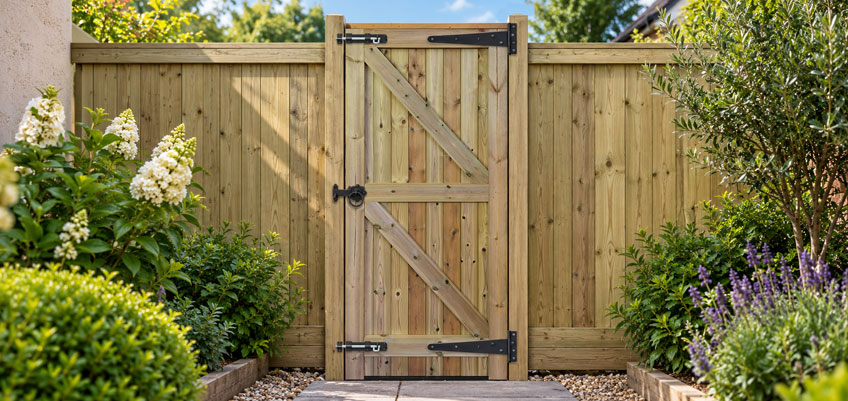
When your gate arrives, check it before storing or installing it.
Make sure:
Any concerns should be reported as soon as the gate is received rather than after it has been stored or installed.
A timber gate that is left unhung can begin responding to its new environment immediately, so we recommend installing your gate as soon as reasonably possible.
A wooden gate doesn’t stop being a natural product when it leaves the manufacturer.
Timber is hygroscopic. In simple terms, this means it naturally absorbs and releases moisture as it attempts to reach a balance with the surrounding environment.
As its moisture content changes, timber can expand, contract, bow or twist.
A newly manufactured gate may leave the workshop straight and square but subsequently experience movement as it acclimatises to the conditions at its new location.
For this reason, avoid buying a gate and then leaving it unhung for an extended period, particularly if it is going to be exposed to changing weather conditions.
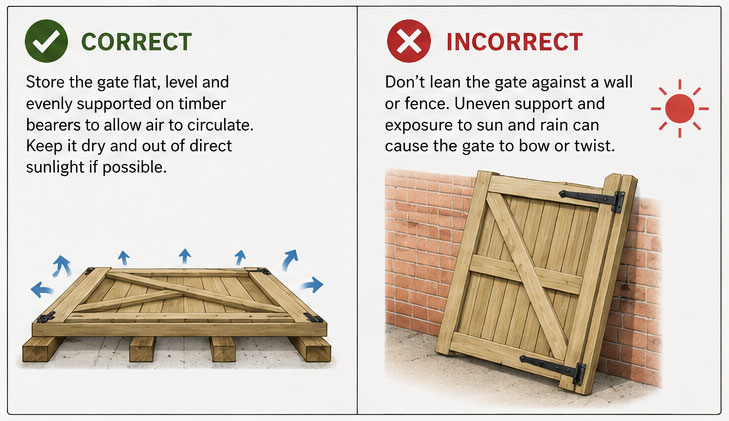
If immediate installation isn’t possible, correct storage is important.
If storing the gate flat, keep it level and properly supported. Its weight should be evenly distributed on timber bearers rather than allowing sections of the gate to remain unsupported. The bearers should also allow air to circulate around the gate.
If the gate has to be stored leaning, make sure its weight is evenly supported.
Wherever possible, store the gate somewhere dry and away from direct sunlight and sources of heat.
Avoid:
Poor storage can encourage movement before the gate has even been hung.
Where new gate posts are also being installed, ideally have the gate and fittings available before finalising the opening.
This allows you to check the actual gate dimensions and take account of the space required by the hinges and closing side.
Installing two posts first and subsequently ordering a gate based purely on the nominal gap between them can create problems.
The type of hinge being used affects the clearance required.
As a general fitting guide for our pedestrian timber gates:
Hook & Band hinges – allow approximately 15 mm.
Tee hinges – allow approximately 10 mm.
The exact arrangement will also depend on how and where the gate is being hung, so establish the complete installation before permanently positioning new posts.
A gate relies on its supporting structure.
Before hanging the gate, check that the hinge post or wall plate is securely installed, structurally suitable and reasonably plumb.
Remember that the hinge side isn’t simply supporting the static weight of the gate. Opening the gate places leverage on the post and its fixings.
The closing post or wall should also provide a suitable surface for the latch, bolts and, importantly, the gate stop.
Trying to compensate for a badly positioned or unstable post by adjusting the gate is unlikely to produce a satisfactory long-term installation.
Don’t attempt to fit a timber gate tightly into an opening.
As well as the clearance required for the hinges, there needs to be sufficient space for the gate to operate without binding.
Remember that timber dimensions can change slightly according to moisture conditions.
You should also allow appropriate clearance beneath the gate so that it can open freely without catching the ground.
Take particular care where paving, gravel or the ground level rises through the arc in which the gate opens.
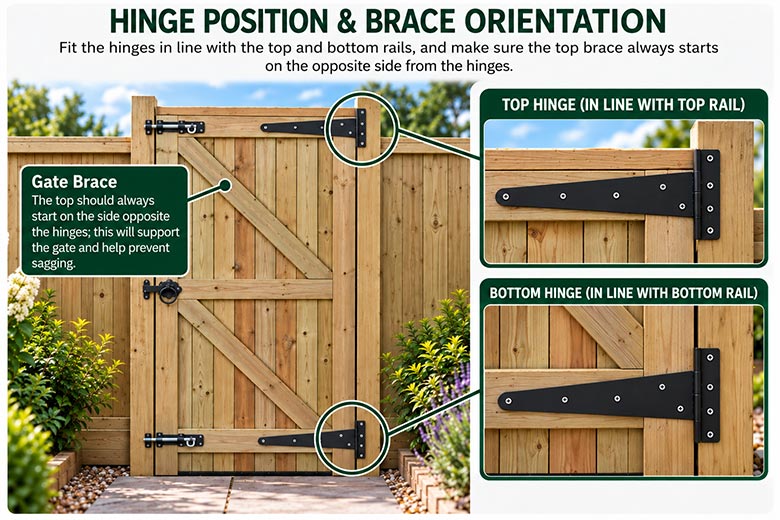
Pedestrian timber gates are commonly installed using either Tee hinges or Hook & Band hinges.
Whichever fittings you choose, they should be suitable for the size and weight of the gate and installed using appropriate fixings.
Before finally fixing everything:
Don’t concentrate solely on making the gate look level while it is open. Its closed position is extremely important because this is where a pedestrian timber gate should spend most of its time.
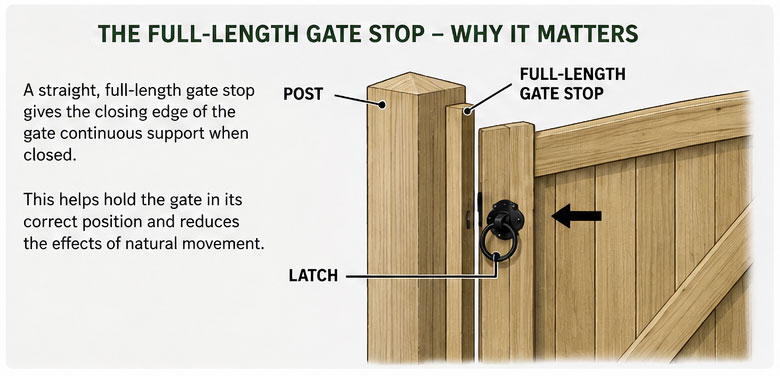
One of the most important parts of a pedestrian timber gate installation is also one of the easiest to overlook: the gate stop.
A gate stop is a straight strip of timber fitted vertically to the closing post for the gate to close against. It physically stops the gate at the correct closed position and provides a straight surface for the closing edge of the gate to rest against.
It shouldn’t simply be a small block positioned around the latch.
Where practical, the stop should extend for approximately the full height of the gate and, most importantly, it should be straight.
Why does this matter?
Because the stop establishes the position in which you want the gate to remain.
When the gate closes against a straight, full-length stop, the closing edge is supported along its height rather than being restrained at only one point by the latch.
This becomes particularly important as the timber experiences seasonal movement.
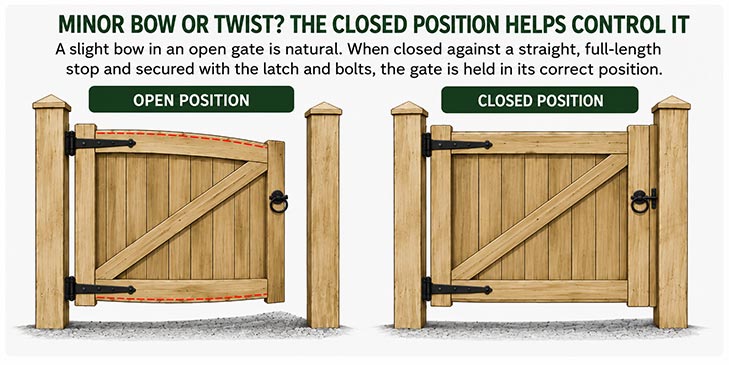
A small amount of movement doesn’t necessarily mean that a timber gate is unsuitable for installation.
If an unhung gate has developed a minor bow or twist, offer it into the opening and see how it behaves when gently brought against a correctly installed straight gate stop.
In many cases, minor natural movement can be accommodated during installation.
The gate stop, latch and top and bottom bolts can then work together to hold the gate in its correct, straight closed position.
There is, however, an important difference between minor natural timber movement and a gate that has become severely distorted.
A gate that cannot reasonably be brought into alignment, cannot operate correctly or has a significant structural problem should be assessed rather than simply forced into position.
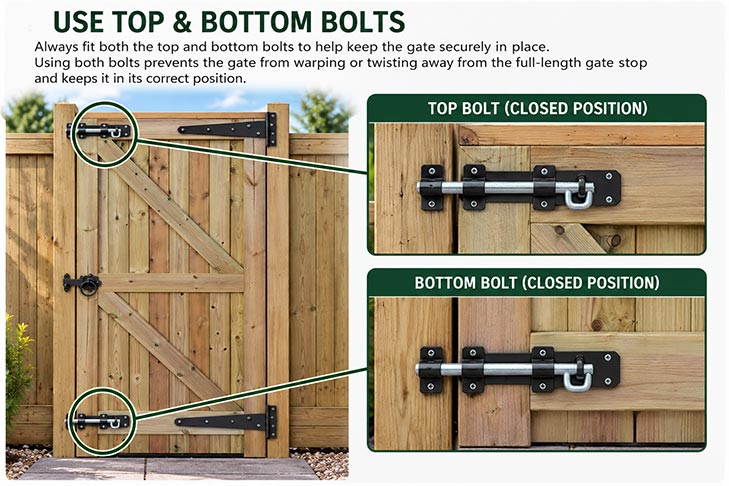
The latch doesn’t just keep a pedestrian gate closed. Together with the gate stop, it helps hold the gate in its intended closed position.
For our timber pedestrian gates, we recommend a central latch together with sliding bolts at the top and bottom. The bolts should be fitted in line with the gate's top and bottom horizontal rails, providing secure fixing points and helping to hold both the top and bottom of the closing edge against the full-length gate stop.
Position the fittings so that the gate is held securely against its stop without unnecessarily forcing or distorting the gate. The objective is to give the timber a consistent straight position in which to settle.
The objective is to give the timber a consistent straight position in which to settle.
Once a new softwood gate has been installed, we recommend keeping it closed and secured whenever it isn’t being used for approximately the first 45–60 days.
Of course, you can open and use your gate normally.
The important point is not to leave it standing open unnecessarily for long periods.
Keeping the gate closed against its straight gate stop allows the timber to weather in and settle while being held in the position in which you ultimately want it to remain.
Think of the gate stop, latch and bolts as working together during this initial period.
Open the gate when you need it; close and secure it again afterwards.
Pressure-treated timber and weather-protected timber are not the same thing.
Pressure treatment helps protect softwood against decay and insect attack. It doesn’t prevent timber from absorbing and releasing moisture or eliminate the effects of sunlight and weathering.
We therefore recommend applying a suitable UV-protective wood oil when the gate is installed.
Follow the treatment manufacturer’s application instructions and ensure that all appropriate accessible faces and edges are treated.
Don’t wait until the gate begins looking weathered before applying its first treatment.
As a minimum, a timber gate should receive a suitable UV-protective oil at least once every year.
For better protection, our preferred maintenance routine is twice a year:
Spring – treat the gate as the weather begins to warm, preparing the timber for the warmer and generally drier months ahead.
Autumn – apply another treatment before the colder, wetter winter conditions arrive.
Regular treatment helps the timber repel moisture and reduces uneven wetting and drying, which can contribute to swelling, shrinkage, bowing and twisting.
Always follow the instructions supplied with the particular treatment you are using.

If possible, avoid installing a new timber gate during a period of exceptionally hot and dry weather.
Strong sunlight and prolonged heat can cause a rapid change in the moisture content of exposed timber. Uneven or rapid drying can increase the likelihood of movement.
Sometimes delaying installation simply isn’t practical.
If you have to install a new timber gate during particularly hot weather, make sure it receives its first application of suitable UV-protective oil as part of the installation.
A further treatment a few weeks later is also advisable during these conditions.
It’s particularly important during this period to keep the gate closed against its full-length stop whenever it isn’t being used.
Many problems attributed to a wooden gate actually begin with how the gate has been stored, installed or maintained.
Here are some of the most serious mistakes to avoid.
Don’t assume that an unhung wooden gate will remain exactly as it was when manufactured regardless of where and how it is stored.
Install it as soon as reasonably possible.
If there has to be a delay, store it correctly.
This can expose different parts or faces of the gate to different conditions while also supporting its weight unevenly.
If leaning is unavoidable, make sure the gate is evenly supported and kept somewhere dry, away from direct sunlight and heat.
If storing a gate flat, support it evenly on level timber bearers with airflow around it.
Don’t simply lay it on uneven ground and leave it.
The type and position of the hinges affect the space required.
Have the gate and preferably its fittings available before permanently establishing a new gate opening.
Measure the actual installation rather than relying solely on a nominal gate size.
Timber moves.
A gate that only just fits on the day it is installed has very little tolerance for seasonal changes in moisture content.
Allow the appropriate hinge and operating clearances.
This is one of the most significant mistakes when installing a pedestrian timber gate.
A latch alone restrains the gate around one small area.
A straight, full-length stop gives the closing edge of the gate a straight surface against which it can be held.
Timber is a natural material, and some movement can occur.
Minor movement may be manageable during installation by bringing the gate into its correct closed position against a straight stop.
That doesn’t mean severe distortion should be ignored. The amount of movement and whether the gate can reasonably be installed and operated are important distinctions.
When open, the gate isn’t being held against its closing stop.
During the first 45–60 days in particular, maximise the amount of time a softwood gate spends closed and secured.
Use it normally, but close it again when you’ve finished.
Pressure treatment provides important protection against decay and insect attack, but it doesn’t make timber immune to moisture movement, sunlight or weathering.
Apply a suitable UV-protective wood oil at installation and maintain the treatment thereafter.
Treatment should be preventative rather than something you only consider once the timber looks weathered.
Treat at installation and at least annually thereafter.
For the best protection, aim for a spring and autumn treatment routine.
Installing an untreated gate during a heatwave and immediately exposing it to intense sunlight isn’t ideal.
If installation can’t wait, treat the gate during installation and consider another application a few weeks later.
The top and bottom bolts help hold the closing edge of the gate against its full-length stop.
Where the gate construction allows, position the bolts in line with the top and bottom horizontal rails so that they are securely fixed into substantial parts of the gate.
When the gate is closed and secured, the latch and both bolts should work together to hold the gate against its straight stop.
No outdoor timber gate can be prevented from reacting to its environment completely.
The aim of good installation and maintenance is therefore not to somehow stop timber being timber.
Instead, we want to manage that natural movement.
Three things are particularly important:
Support it correctly.
Install the gate using suitable posts, hinges, a straight full-length gate stop and appropriate closing hardware.
Keep it in the right position.
When the gate isn’t being used, keep it closed and secured, particularly during its first 45–60 days.
Protect the timber.
Apply a suitable UV-protective oil during installation and maintain that protection throughout the life of the gate.
Following these principles will help minimise unnecessary movement and give your timber gate the best opportunity to provide many years of trouble-free service.
Should I treat a new pressure-treated timber gate?
How often should I oil my wooden gate?
Do I need a gate stop on a pedestrian gate?
How long should I keep a new timber gate closed?
Can I hang a wooden gate that has a slight bow?
Why has my wooden gate moved?
Can I install a timber gate during hot weather?
Should I leave my timber gate open?