Special Offers
Download The Challenge fencing Brochure

How to Guide - Planning a Fence

Fences make a great addition to any house or garden. A well built wooden fence can afford a measure of security and privacy. At Challenge Fencing you will find a wide variety of fence designs and materials. Why not pop down to your local branch and have a look round at our huge range?

PURPOSE

You need to know what you want the fence to accomplish before you purchase anything or start building. Are you looking to keep animals in and intruders out, or looking for something decorative. Knowing this, you will have saved yourself a lot of time and money and you will not have to worry about changing your fence just a couple years down the line.

PLANNING

Regardless of the type of fence you plan to build, be sure you know exactly where your property line is located. If you are uncertain about the location of the line, look at your title deeds. Check who is responsible for the upkeep.
Check with your local planning office regarding any restrictions applying to fences before beginning construction.

SELECTING THE RIGHT STYLE

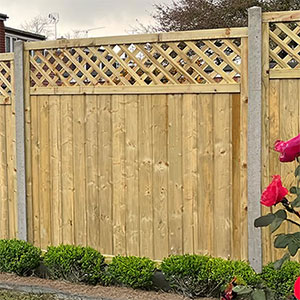
Determine the type and height of fence you require to meet your needs. Six foot is normal for a privacy fence, These fences are typically built to provide home owners with privacy as well as security while they relax in their homes. Fence panels can be stained, painted or left natural. They can be plain or decorative, with lattice, shrubbery or plants and can provide very attractive barriers along property lines. (A livestock fence of four feet high is usually sufficient, and picket fences are often three feet high).

CALCULATING WHAT TO BUY

Decide if you want wooden or concrete posts and whether to set them in concrete or use post supports. Post supports are metal 'containers' that are dug into, or fixed onto the ground. Concrete posts make sure the fence is sturdy, but require a fair amount of work. Wooden posts are buried in the ground, so there is a slightly higher risk that they will rot. Metal post supports overcome some of these problems, and enable you to erect a fence relatively quickly.

POST LENGTHS

Decide on the finished height of your fence. If you are burying wooden posts in concrete you will need 8ft posts for a 6ft (1.8m) fence i .e. 2ft (0.6m) longer than the height of the fence. Alternatively, if you use post spikes or bolt-down post sockets, you will need 6ft posts for a 6ft fence. If you use post spikes remember to check for pipes and electric cables in the ground as the spikes go down to a depth of 18 inches. Use 4in x 4in posts for fences of 6ft and over, or 3in x 3in posts for anything under 6ft.

FENCE PANELS

Are nearly always 6ft (1.83m) wide. Measure the length of the area that needs fencing and divide the length by the width of the panel e.g. for a 36ft fence, 36ft divided by 6ft = 6 panels. You will also need the same number of gravel boards to place at the bottom of each panel. Always add one more fence post to the number of fence panels needed, so that you have enough posts to support both ends of the fence. You will need to know how to use a hammer and a drill, along with various types of saws.

PREPARATION

Clear away vegetation and treat the area with weedkiller. Most fence panels and wooden posts are pre-treated to prevent rot and insect attack, but it is necessary to treat any sawn end with an all-purpose wood preservative.
Determine the fence line and mark it out with a string line. Continue the string line 600mm (2ft) past each end of the fence line and tie each end to stakes hammered into the ground. Ensure the string line is taut and not touching the ground at any part.